Consulting in the age of AI: what I'm seeing
Clients want fewer hours and shorter projects, and ask how much AI cuts timelines. What I see from inside a consultancy and what the data says.

- published
- read
- 6 min
On this page
TL;DR
AI isn't killing off technology consultancies, but it is shrinking the classic project: with long-standing clients there's less presales work, fewer long projects, implementations of off-the-shelf solutions such as a CRM get questioned much more, and practically the only question is how much AI cuts timelines. Market data confirms the direction (contracts being renegotiated, deflation at the big integrators, half of Accenture's bookings in managed services), but not a collapse: the change is real and gradual. The big open question is whether the offering should move from project to product; a Stanford paper points to hybrid and asset-based contracts. The risks are the variable cost of tokens, estimating on top of someone else's tools, reskilling people at the pace the market demands, and vendor lock-in.
A CIO told me recently, with no beating about the bush: “Andrés, if the project’s going to take more than 3 to 6 months, don’t even bother.” Other clients apply the same rule, even if nobody has put it quite so bluntly.
In short: AI is shrinking the classic consulting project — less presales, fewer hours and shorter timelines — and data from the large-enterprise market confirms the direction, but not a collapse.
I don’t have a finished thesis. I have what I’m seeing, what the data says and one question: whether a consultancy’s offering has to move from project to product. I run Infoavan, a Microsoft partner, so I read this shift as an opportunity. Bear that in mind.
What I’m seeing with long-standing clients
- Presales is shrinking. Above all for the classic project.
- The usual work comes up less. Body shopping, traditional support and long-running development.
- Implementations of off-the-shelf solutions get questioned much more. A CRM, for example. This is the observation that bothers me most.
- The question is the timeline. How we bring AI into projects and how much it cuts timelines.
My answer is usually an invitation: see it with your own eyes. We set up an executive breakfast and build things live in front of them, or we show them what we’ve done for other clients, without naming them. They leave with a clear idea of the platform’s potential.
This is what I’m seeing, not a statistic: I haven’t found public data that confirms it. There is an indirect clue, though: Microsoft already sells agents within Dynamics 365 Sales that qualify leads and manage opportunities[1], and the Sales Qualification Agent has been generally available since October 2025[2]. If an agent does part of the CRM’s work, it makes sense that the usual implementation gets questioned more.
What the data says (and what it doesn’t)
The large-enterprise market is heading the same way, at a different pace.
- Contracts are being reopened early. HFS Research reports that clients are renegotiating IT services contracts within 24 months of signing, without waiting for renewal. According to Phil Fersht, conversations are moving away from FTEs, rates and offshore ratios and towards productivity commitments, outcome-based pricing and gain-sharing[3]. These are comments from analysts and executives, not a survey.
- The big integrators are talking about deflation. According to The Register, TCS closed its financial year with revenue down 0.5%, and its CEO called the deflation “degrowth”; HCL grew in FY26 but expects “AI deflation” the following year[4]. The same article notes that Infosys expects it further down the line and that headcounts barely moved.
- Half of the biggest player’s bookings are already managed services. Accenture closed FY26 with $84.54 billion in bookings, of which $43.67 billion were managed services: more than consulting[5].
What the data doesn’t show is a collapse. Accenture grew 5% in local currency and expects between 3% and 6% for the following year[5]. The change is real, but slower than the headlines.
From project to product: the question I can’t answer
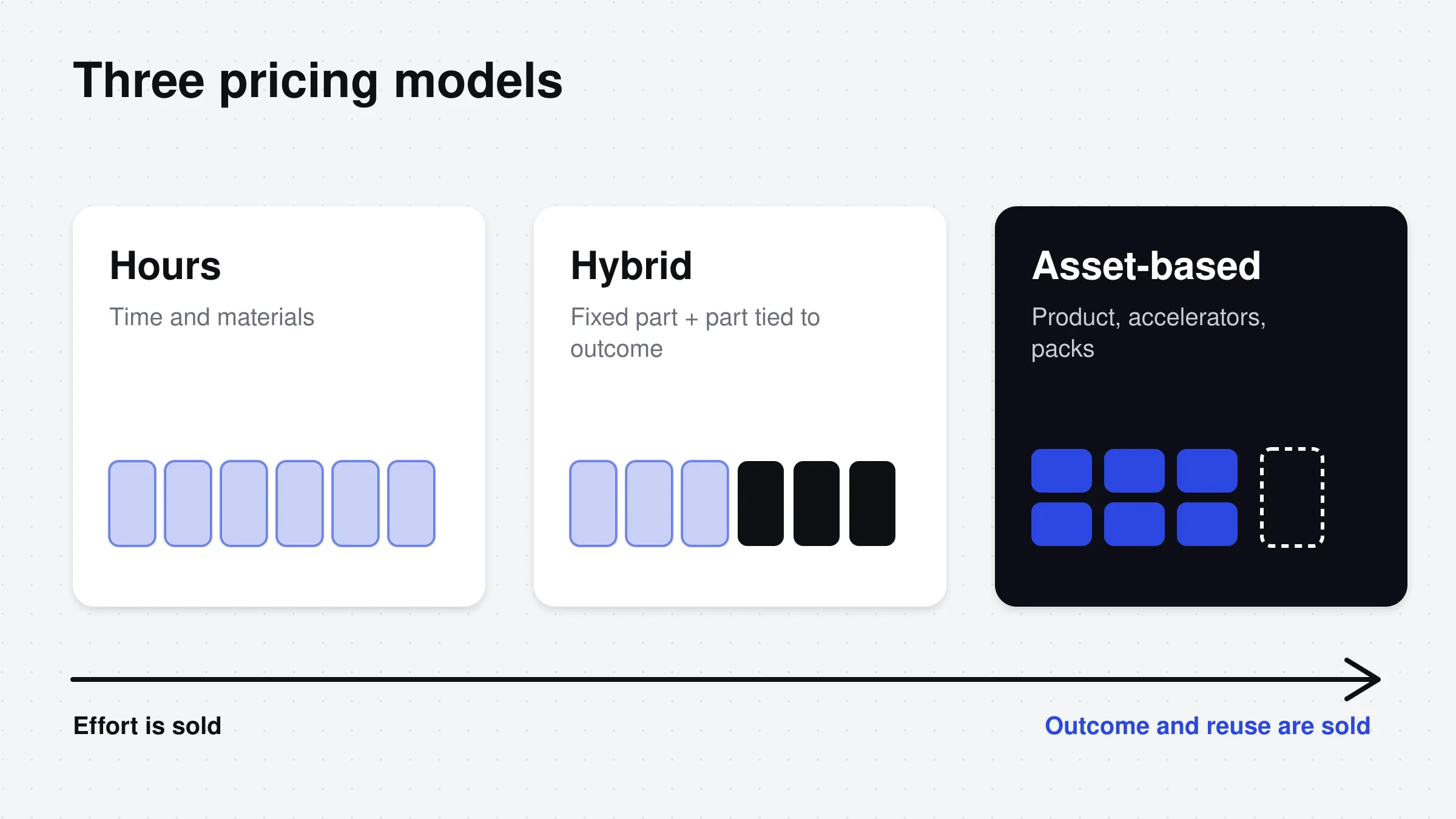
In August, Erik Brynjolfsson (Stanford Digital Economy Lab) and Georgios Petropoulos (University of Southern California) published a paper on how to price consulting in the agentic era. Their conclusion is that AI “tends to push consulting firms toward hybrid and asset-based structures”, and that pure time-and-materials billing survives only at the margins[6]. The lab received a donation from Accenture, which, according to the authors, neither commissioned the study nor had any right to review it; they did, however, speak informally with three Accenture executives.
I find the argument convincing: with AI built in, the client sees the outcome, not the hours. Time and materials stops fitting, and fixed pricing only works if the cost and the deliverable are observable; the norm will be hybrid pricing, with a fixed part and a part tied to the outcome[6]. The hard part is attributing that outcome when your contribution blurs into the client’s. I’d add that this attribution has to be agreed with the client from the outset.
My reading is that the industry is moving from projects to its own IP, accelerators and managed services that run what has been built. Stanford speaks to IP and proprietary assets with its “asset-based structures”[6]; Accenture’s bookings speak to managed services[5].
At Infoavan we’re trying it out along three lines:
- Our own product. We didn’t used to see ourselves as capable of developing, selling and maintaining a product. Today building costs far less, although the bottleneck shifts to review, as I explained in More code, not more software.
- Implementation accelerators. So that the projects that do go ahead take less time.
- Business process agentification packs. Agents built around a specific process, repeatable across clients.
It’s all at the testing stage, and we won’t be the only ones: the vendor already sells ready-to-use sales agents[1]. It’s the flip side of SaaS is dead (almost): if building costs less, the client can also build it in-house.
The vendor is making its move too. According to CRN Asia, in its FY27 Microsoft scores its partners, for incentives and badges, on their ability to build and deliver agents[7]. It has also published the AI-First Partner Transformation Playbook, material for partners whose content I won’t go into. According to the distributor Infinigate, the aim is to grow service value and update go-to-market and monetisation[8]. Mind you, Microsoft wins if its partners build agents on its platform: it’s a sign of where it’s pushing, not of where the market is going.
The risks I see
- The cost of tokens. A product with agents brings a new variable cost. The FinOps Foundation proposes estimating it in four steps, starting with the volume consumed in the billed metrics, such as tokens[9]. Microsoft recommends deploying a test workload and comparing the actual meters with your assumptions, and warns that Azure OpenAI doesn’t currently offer hard spending limits: only budgets, alerts and custom automations[10]. It can be estimated, not known in advance: with AI built in, a fixed price is risky.
- Estimating on top of someone else’s tools. If you depend on another company’s models, agents and licences, your estimate inherits its roadmap and its prices.
- Reskilling people. The industry’s hardest challenge. TCS reports more than 270,000 professionals with advanced AI skills and an average of over 120 hours of training per employee[11], although it’s a self-report that measures training received, not effective reskilling. At the other end, Julie Sweet, Accenture’s CEO, explained in 2025 that for some profiles, with such compressed timelines, “we don’t have a viable path for skilling”, and that the answer was to part ways with those people[12]. Training lots of people is possible; reskilling everyone at the pace the market demands, less so — and not everyone wants to come along.
- Lock-in, more than ever. For a Microsoft partner it’s twofold: the vendor’s roadmap and a partner programme that pushes towards its platform. As I explained in Stop marrying one model, lock-in has moved from the model to the harness: whatever you build has to survive a change of vendor.
What isn’t changing (or remains to be seen)
The data calls for caution. Capgemini has raised its 2026 growth forecast to between 9% and 9.5% at constant currency, although around 5 points come from acquisitions; by my calculation from its release, organic growth sits at around 4–4.5%[13]. Demand is still there; what’s changing is what gets bought and how quickly.
Trust isn’t disappearing either, but it’s earned by showing impact on costs and timelines, in short cycles: that’s the other side of the CIO’s rule.
What I’ll keep watching
The clients I see are buying fewer and fewer hours and long projects, and more speed. I don’t know whether the answer is product, hybrid contracts or a mix; what I do see is that the usual offering is less and less enough.
In upcoming posts I’ll share how we’re testing this at Infoavan: what works and what doesn’t.
If you run a consultancy or work at one, I’d like to know what has changed in your presales this year.
Key takeaways
- Ask your long-standing clients what has changed in what they ask you for, and open the conversation with the timeline, not the scope.
- Try something repeatable (an accelerator, an agent pack or a product), knowing you won't be the only one and that the platform vendor sells agents too.
- Measure the variable cost of AI under real load before committing to a fixed price; if you can't observe the cost and the deliverable, propose hybrid pricing.
Frequently asked questions
How is AI affecting technology consultancies?
Clients are asking for shorter projects and want to know how much AI cuts development timelines. In the large-enterprise market, clients renegotiate contracts before renewal and there's talk of moving from paying for people (FTEs) to paying for outcomes. The big Indian integrators already mention AI deflation. The change is real, but gradual: Accenture is still growing, albeit at a low rate.
Will body shopping disappear?
The data doesn't show that. With long-standing clients, body shopping, traditional support and long-running development work come up less often, but that's the author's observation, not a statistic. In the large-enterprise market, clients are steering the conversation away from FTEs and rates and towards productivity commitments and outcome-based pricing (HFS Research), and the paper by Brynjolfsson and Petropoulos (Stanford) concludes that pure time-and-materials billing survives only at the margins.
Should consultancies move from projects to products?
That's the big open question. A paper by Brynjolfsson and Petropoulos (Stanford Digital Economy Lab, 2026) concludes that AI pushes consultancies towards hybrid and asset-based structures, and that pure time-and-materials billing survives only at the margins. Building a product is more feasible than ever, but it's also more feasible for the competition and for the platform vendor itself.
What are the main risks for a consultancy selling AI?
The variable cost of tokens, which can be estimated but not known in advance; estimating projects that depend on third-party tools; reskilling people at the pace the market demands; and vendor lock-in, both to its product roadmap and to its partner programme.
How should AI projects be priced? Does fixed pricing work?
Fixed pricing only works if the cost and the deliverable are observable; with agents, the variable cost of AI usually makes that hard. The norm will be hybrid pricing, with a fixed part and a part tied to the outcome, according to Brynjolfsson and Petropoulos. The FinOps Foundation proposes estimating cost from the volume consumed (tokens, for example) and from reference architectures, and Microsoft recommends deploying a test workload and comparing the actual meters with your assumptions. Azure OpenAI doesn't currently offer hard spending limits: only budgets, alerts and automations that have to be built to measure.
Sources
- AI agents in Dynamics 365 Sales — Microsoft Learn, 2026-09-25. learn.microsoft.com
- Dynamics 365 sets the bar for agentic sales qualification on new benchmark — Microsoft Dynamics 365 Blog, 2025-12-11. microsoft.com
- AI drives IT contract renegotiations within 24 months as pricing models shift — HFS Research, 2026-06-30. hfsresearch.com
- 'AI deflation' comes to India's tech services giants and puts downward pressure on revenue — The Register, 2026-04-28. theregister.com
- Accenture Reports Fourth-Quarter and Full-Year Fiscal 2026 Results — Accenture (SEC), 2026-10-01. sec.gov
- Pricing Consulting Services in the Age of Agentic AI: A Strategy Map for Executives — Brynjolfsson and Petropoulos (Stanford Digital Economy Lab), 2026-08-23. digitaleconomy.stanford.edu
- Microsoft's Nicole Dezen Unveils New Partner Strategy Built Around AI Transformation — CRN Asia. crnasia.com
- Microsoft Partner Program Updates: March 2026 — Infinigate Cloud, 2026-03-03. infinigate.cloud
- Effect of Optimization on AI Forecasting — FinOps Foundation (FinOps for AI), 2026-03-17. finops.org
- Plan and Manage Costs - Microsoft Foundry — Microsoft Learn, 2026-10-22. learn.microsoft.com
- Human Capital | TCS Integrated Report 2026 — TCS. ar.tcs.com
- Accenture's $865 million reinvention includes saying goodbye to people without the right AI skills — Fortune, 2025-09-27. fortune.com
- Q3 2026 revenues — Capgemini, 2026-10-30. investors.capgemini.com