More code, not more software: the bottleneck is review
Coding agents push commits and PRs up 36%, but not the software shipped. Review takes 56.1% longer. Here's how to redesign it.

- published
- read
- 7 min
On this page
TL;DR
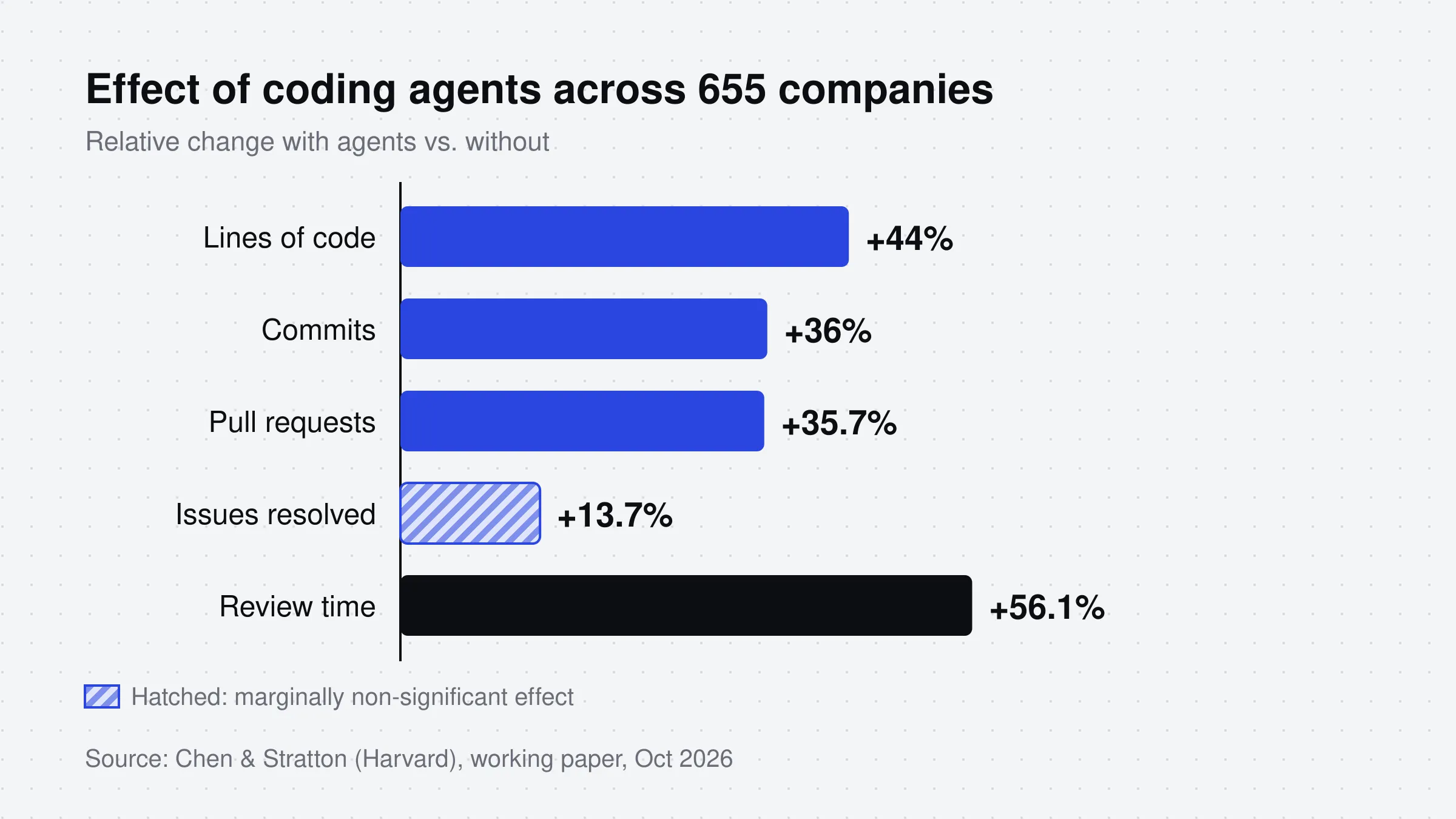
Coding agents send activity soaring (with agents, 44% more lines and 35.7% more pull requests, according to a Harvard working paper covering 655 companies), but the work actually delivered shows no detectable change and review time rises by 56.1%. The bottleneck is no longer writing code, it's reviewing it. The answer is to measure quality instead of activity, write explicit standards that both people and agents apply, use agentic review with different models, and coordinate before launching agents, for example with spec-driven development.
My team builds internal tools every day with Claude Code and GitHub Copilot. But writing is no longer what slows us down: what slows us down is reviewing what the agents write. My thesis is simple: if you measure activity, agents look like a success; if you measure software delivered, not so much. The bottleneck has moved to review, and review has to change.
I’ll say it with my conflicts of interest declared up front. I run a Microsoft partner, and GitHub — owner of Copilot and author of the Octoverse and Spec Kit, both of which I cite below — belongs to Microsoft. I also use Claude Code, from Anthropic, every day, and Anthropic has just launched its own review product. Several sources in this post sell exactly what they describe, and I point it out where it matters.
What the data says: more code, not more software
The volume is beyond dispute. GitHub’s Octoverse counts 34.3 billion commits between October 2025 and September 2026, compared with 12.9 billion the year before. And pull requests (PRs) opened by agents exceeded 40% in September 2026, up from 17% in March[2].
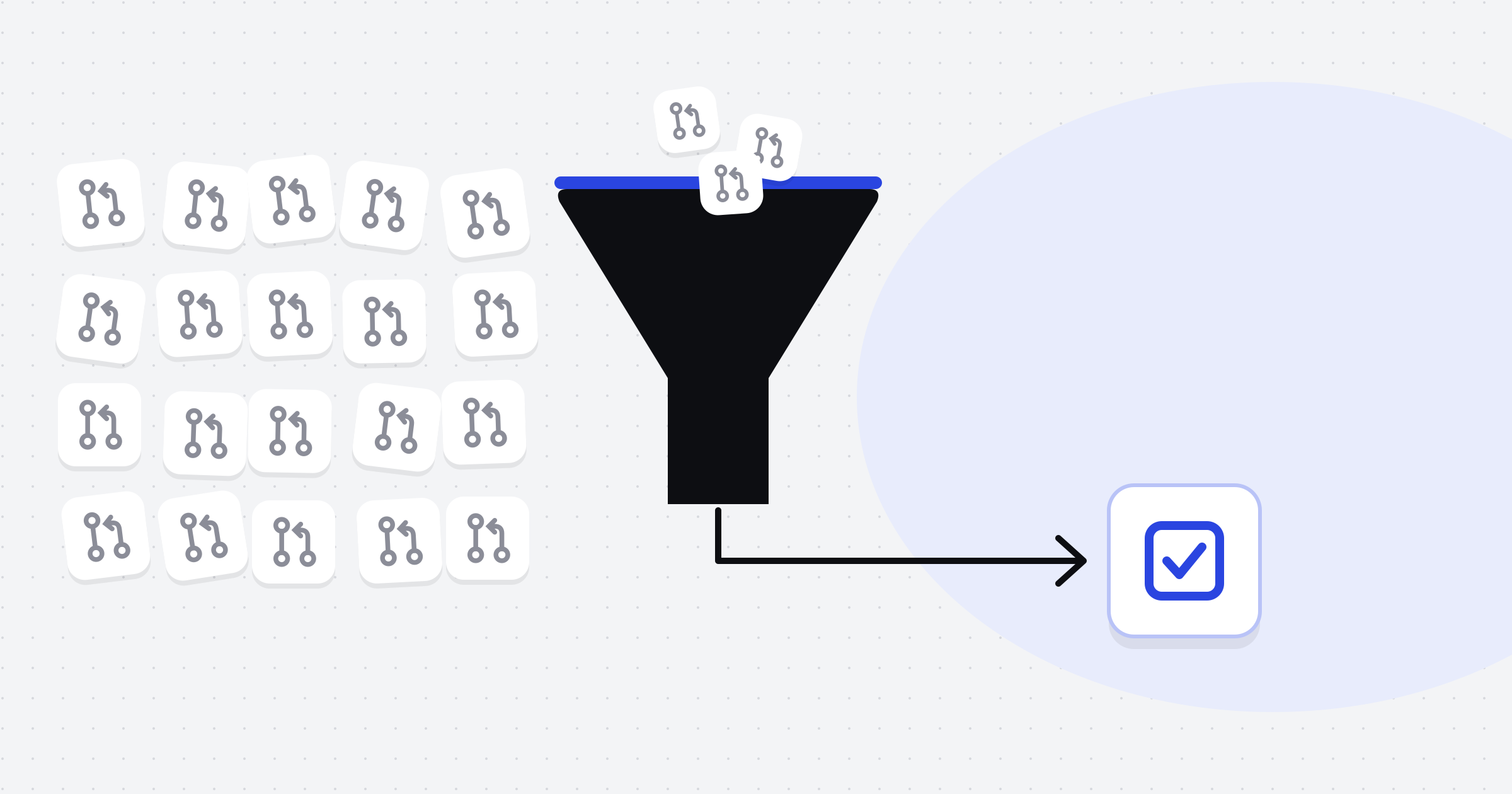
What’s interesting is what happens to that volume inside companies. A Harvard working paper (Chen and Stratton, version of 31 October 2026) analyses Jellyfish data from 655 companies and 720,542 workers between January 2021 and August 2026[1]. With agents, lines of code added rise by 44%, commits by 36% and PRs opened by 35.7%.
But resolved Jira issues rise by 13.7% and epics by 18%, and both effects are marginally non-significant. In other words: no detectable change in what actually gets delivered. The authors rule out resolved issues growing by more than 30.7% (and epics by more than 41.5%), well below the 44% for lines[1].
It makes sense: according to the same paper, engineers spend only 30% to 40% of their time writing code. Writing code is one thing; delivering software is another.
Where it gets stuck: review
The same study shows where the work piles up. With agents, the time from when a change is submitted for review until it’s approved or merged rises by 56.1%, on an average of 3.56 days. Time in the queue before anyone looks at it rises by 59.9%, active review time by 58.5% and comments per change by 38.6%. The abstract puts it literally: “Code review becomes the bottleneck”[1].
Two nuances matter:
- It didn’t happen with assistants. The previous generation, assistants that make suggestions in the editor or in a chat, shows no significant effect on review. The bottleneck appears with agents.
- Reviewing costs more, but the code isn’t worse. The number of bugs reported per person doesn’t rise significantly; the estimates are even slightly negative. The problem isn’t the quality of the code, it’s the cost of checking it.
There’s another figure I think is key. Reviewers mostly review code they already know: 82.8% of reviews, compared with the 17.2% you’d get with random assignment. And seniors’ code is reviewed by seniors in 75.7% of cases[1]. A junior engineer interviewed in the paper describes how, after outages caused by AI-generated commits, senior approval became mandatory for AI-generated code, and that created even more of a bottleneck.
Review isn’t interchangeable. You don’t fix it by assigning it at random or by adding more reviewers.
The problem starts earlier: coordination
Part of the problem isn’t in review at all, but before it. With agents, people no longer stop to think about what needs doing. If they have an idea, they throw it at the agent.
We lived through this recently. There was a specific need in the team and I started building something to solve it. Someone else did the same, in the same environment. We collided and ended up with a pile of pull requests trying to build practically the same thing. Reviewing all that was very hard.
We solved it with two changes. First, a central repository and backlog with the status always up to date, so anyone can see what’s being built before launching an agent. Second, isolated development environments, as easy as possible to spin up at any moment, so that two pieces of parallel work don’t tread on each other.
From there I argue for going one step further: adopting spec-driven development as the standard. That is, writing and agreeing on the specification before launching the agent. GitHub Spec Kit organises it into four phases (Specify, Plan, Tasks, Implement), with focused reviews at each one instead of one big code dump[5]. AWS’s Kiro generates requirements, design and task documents[6].
That this reduces collisions is my opinion, not a fact: I don’t know of any study that measures it. But the logic seems sound to me. If the spec is written and agreed, it’s hard for two people to solve the same thing without knowing it, and the reviewer has something explicit to compare the code against.
How review needs to change
We’re still reviewing the way we did in traditional development cycles, and that no longer fits. Agents write the code, but what we have to guarantee is that it follows our working standards. This is what I propose:
- Explicit standards. Security, performance, scalability, best practices and internal standards, written so that either a person or an agent can apply them. Technical people set them, not the agent.
- Agentic review with other models. Reviewer agents that don’t use the same model that wrote the code, and agents specialised in security, performance or scalability. Anthropic has just made Code Review generally available for Team and Enterprise organisations, with Quick, Standard and Deep levels per repository[3]. The Octoverse shows that 61% of Copilot users who choose a model used more than one in September 2026[2], although that describes usage, not quality.
- Humans where it matters. Judgement, understanding of the full feature and the final decision are still ours.
- Measure quality, not activity. Time from when a PR is opened until it reaches production (not just until merge), change failures and recovery time, PRs reworked, duplicated or closed without merging, and waiting time in the review queue.
There’s a lot of room to improve. According to the paper, as of July 2026, 79.1% of companies have used AI in review, but only 23.3% of comments are AI-generated and only 10.8% of PRs receive one[1].
This isn’t just an engineering matter. CTOs and engineering leads decide what gets measured and which standards get written. Developers coordinate before launching agents and keep PRs small. And the decision-makers and business users who now build with AI, low-code included, are producing software (building keeps getting cheaper, as I argued in SaaS is dead (almost)). They’re part of the quality chain. DORA sums it up well: AI acts as an amplifier that magnifies the strengths and weaknesses an organisation already has[4]. If there are standards, it amplifies them; if not, it amplifies the chaos.
If I had to start on Monday:
- Write down your standards. Security, performance, scalability and best practices, applicable by people and agents.
- Add agentic review. With a different model from the one that wrote the code and at least one reviewer specialised in security.
- Coordinate before launching agents. One issue or one owner per task, and check whether someone is already on it.
- Adopt spec-driven development. With Spec Kit, Kiro or your own template, with the weight scaled to the size of the change.
- Stop celebrating commits and PRs. Measure how long a change takes to reach production and how often it fails.
When the thesis doesn’t hold
I don’t want to sell this as a law. There are clear limits:
- The paper measures an average and is a working paper, not yet peer-reviewed. The companies are Jellyfish customers who agreed to take part, probably companies that already measure their engineering. In a team with good tests and CI, the bottleneck may be somewhere else.
- It may be temporary. The paper’s own simulation depends on whether review productivity rises at the same pace as writing productivity. Agentic review may shift that limit.
- The Octoverse partly points the other way. In September, 90% of agent PRs were merged within two weeks, while PRs with no agent detected stay at around 86%[2]. They’re different populations and measures, and I don’t know whether it means review slows things down less or that less reviewing is happening.
- Spec-driven development has a cost. Birgitta Böckeler watched Kiro turn a minor bug into four user stories and sixteen acceptance criteria, and Spec Kit generate repetitive Markdown that was tedious to review[7]. Her evaluation is from October 2025 and the tools have changed (Kiro now offers Quick Spec[6]), but the warning stands: a light spec, or none at all, for small fixes. And a spec doesn’t guarantee the agent will follow it.
- Agentic review has its own risks. False positives, cost, and the temptation to let one agent approve another’s work without human judgement. And the people selling these tools are, in part, the ones publishing the data.
- My experience doesn’t generalise. It’s qualitative, and I can’t publish my own figures.
Generating code is cheap
Generating code is cheap; understanding, validating and owning that code is not. Teams that keep measuring commits and PRs will see a success on the dashboard and a traffic jam in production.
In upcoming posts I’ll share how I’m testing this in practice, including what works and what doesn’t.
And I’ll leave you with a question: has your team measured how long an agent’s PR takes to reach production compared with one written by hand?
Key takeaways
- Stop celebrating commits and pull requests; measure how long a change takes to reach production and how often it fails.
- Write down your security, performance, scalability and best-practice standards so that both people and reviewer agents can apply them, using a different model from the one that wrote the code.
- Coordinate before launching agents, with a central backlog and an agreed spec scaled to the size of the change.
Frequently asked questions
Do coding agents increase a software team's productivity?
They increase activity, but there's no detectable change in what gets delivered. According to a Harvard working paper covering 655 companies, with agents the lines of code added rise by 44% and pull requests opened by 35.7%, while resolved Jira issues rise by 13.7%, an effect that is marginally non-significant. It's a working paper that hasn't been peer-reviewed, and it measures an average.
Why is code review the new bottleneck?
Because with agents, more code gets written than can be reviewed at the same pace. The time from when a change is submitted for review until it is approved or merged rises by 56.1% on an average of 3.56 days, and time waiting in the queue rises by 59.9%. Engineers spend only 30% to 40% of their time writing code.
Does agent-generated code have more bugs?
According to the same study, not significantly. The number of bugs reported per person doesn't rise, and the estimates are even slightly negative. The problem isn't the quality of the code, it's the cost of checking it.
How should code review change with agents?
With explicit standards for security, performance, scalability and best practices that both people and agents apply; with agentic review by models different from the one that wrote the code; with humans in charge of judgement and the final decision; and by measuring quality (time to production, failures, PRs reworked or closed without merging) instead of activity.
What is spec-driven development and what role does it play here?
It means writing and agreeing on the specification before launching the agent. GitHub Spec Kit organises it into four phases (Specify, Plan, Tasks, Implement), and AWS's Kiro generates requirements, design and task documents. That it reduces collisions between agents is the author's opinion, not a measured fact, and it has a cost for small changes.
Sources
- Artificial Intelligence in the Firm: Bottlenecks in Software Production (working paper, version of 31 October 2026) — Chen and Stratton (Harvard), 2026-10-31. fion.ac
- Octoverse: Commits, pushes, reach new highs in 2026 as developers build with agents — GitHub, 2026-10-28. github.blog
- Code Review is now generally available — Anthropic, 2026-10-15. claude.com
- State of AI-assisted Software Development 2025 — DORA (Google Cloud), 2025-09-23. dora.dev
- Spec-driven development with AI: Get started with a new open source toolkit — GitHub, 2025-09-02. github.blog
- Specs — AWS (Kiro), 2026-10-15. kiro.dev
- Understanding Spec-Driven-Development: Kiro, spec-kit, and Tessl — Birgitta Böckeler (martinfowler.com), 2025-10-15. martinfowler.com